Stay Up To Date With Slidebuys
Get in-store discounts, giveaways, tips, and useful advice by joining our Slide buys customer rewards & newsletter for free.
[yikes-mailchimp form="1"]
Wondering when should I use crampons? Learn how snow, ice and terrain on Mt Ruapehu guide your gear choice for safer alpine travel in winter conditions.
A crisp winter day on Mt Ruapehu can make an alpine walk feel like the highlight of a New Zealand trip. If you are asking, “when should I use crampons?”, the short answer is: when firm snow or ice makes normal boots unable to grip securely – and when you have the right equipment, skills and conditions to use them well.
Crampons are not standard gear for every snowy outing. They are specialist traction tools designed for steep, hard or icy alpine terrain. Knowing the difference between a frosty track, soft snow and true mountaineering conditions will help you choose gear that suits your day rather than carrying more than you need.
Use crampons when the surface is hard enough that the lugs on your boots cannot bite in reliably. This often means frozen snow, refrozen slush, hard wind-packed snow or ice, particularly where the ground is sloping. On Mt Ruapehu and around Tongariro National Park, conditions can change quickly with elevation, wind, shade and time of day. A track that is soft underfoot in the morning can become firm and slippery after a cold snap, while sun-exposed slopes may soften sooner than gullies or shaded sections.
Crampons provide metal points beneath your boot to grip into hard snow and ice. That grip matters most when a slip could gather speed or carry you into rocks, a steep run-out or an exposed slope. They are commonly used for winter mountaineering, glacier travel, steep snow climbs and alpine routes where ice axe skills are also required.
They are not usually necessary for skiing, snowboarding, sightseeing at Whakapapa, sledding, or a first visit to Happy Valley. For these activities, warm waterproof clothing, appropriate boots and sensible movement on packed snow are the priorities.
Deep, soft snow is not automatically a crampon situation. In fact, crampons can be awkward in soft powder, where snowshoes or simply careful boot travel may be more suitable. The key question is whether the snow is firm enough to support your weight and whether your boots are sliding rather than holding.
Ice is more obvious, but hard snow can catch people out. It may look like ordinary white snow from a distance, yet feel as hard as concrete once you step onto it. If you cannot kick a secure step into a slope with your boot, and the terrain is steep enough that a slip has consequences, crampons may be appropriate.
Crampons work as a system with your boots. Full mountaineering crampons are generally fitted to stiff, compatible boots with a firm sole. A flexible hiking boot can allow the crampon to move, loosen or sit poorly underfoot. That is uncomfortable at best and unsafe on firm terrain.
Before heading out, check that the crampons fit your exact boots, not just the stated shoe size. They should be adjusted securely, with no excess movement at the heel or toe. The points need to sit evenly under the boot, and straps must be correctly fastened without loose ends that can catch.
Using crampons also changes how you walk. On flatter ground, take a slightly wider stance so you do not catch a point on your opposite trouser leg or boot. On slopes, place your feet deliberately and make each step count. Avoid rushing, crossing your feet or walking too close behind someone else. A crampon point caught in clothing can turn a small stumble into a fall.
For steeper snow, crampons are commonly paired with an ice axe. Carrying an ice axe without knowing how to use it is not a substitute for experience. Self-arrest, safe movement on snow and route judgement are practical skills best learned through instruction and practice in suitable terrain.
It is easy to group all traction devices together, but they are built for different conditions. Choosing the right one is part of good trip planning.
Microspikes or lightweight trail traction devices use short metal points or coils under a flexible harness. They can be useful on relatively flat, icy walking tracks, frozen paths and low-angle packed snow. They are not a replacement for mountaineering crampons on steep or exposed ground.
Crampons have larger, sharper points and a more secure attachment system. They are designed to penetrate firm snow and ice and give dependable purchase on serious alpine terrain. They demand compatible boots and a higher level of skill.
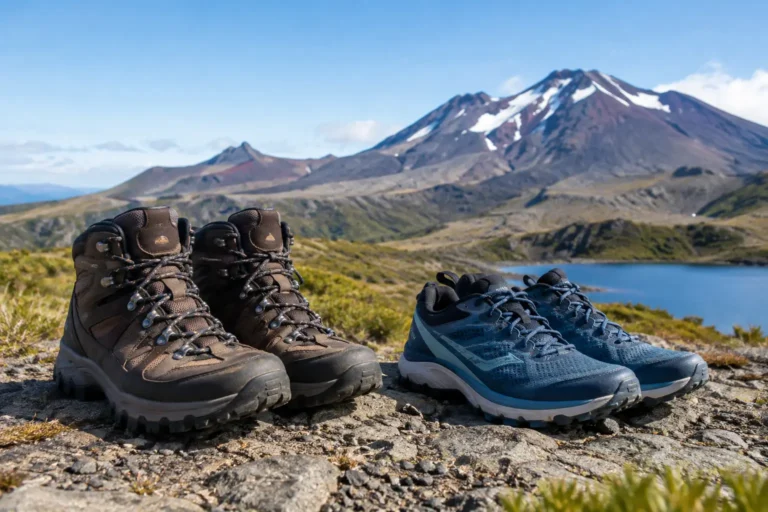
Ordinary hiking boots remain the best choice when tracks are clear, muddy, wet or covered in soft snow. Good tread, supportive fit and waterproofing will do more for comfort than adding traction gear that the conditions do not require.
A useful rule is this: if conditions call for full crampons, the route may also call for winter experience, an ice axe, an understanding of avalanche conditions and a conservative decision-making approach. Crampons are one part of the plan, not permission to enter terrain beyond your ability.
A summer Tongariro Alpine Crossing is a marked day walk, but winter transforms the landscape. Snow can obscure markers, ice can form on steep sections and visibility can disappear in cloud. Winter travel may require specialist equipment and expertise well beyond a normal hiking day.
Check the latest mountain forecast, track advice and any access information before setting out. Pay attention to freezing levels, wind strength, recent snowfall, overnight temperatures and visibility, not just whether rain is predicted. A strong wind can strip exposed slopes bare, leaving hard ice, while sheltered areas retain deep snow.
It also helps to think about timing. Firm early-morning snow may soften later in the day, then refreeze as temperatures drop. If your route includes a steep section, assess it before committing. Turning around while the ground is still manageable is good judgement, not a failed objective.
Ask a local professional for current, route-specific advice when conditions are wintry. The Alpine Centre team in National Park Village can help visitors understand the difference between gear for a snowplay day, a ski day and a properly planned alpine outing.
Crampons are not useful if they are worn simply because there is snow on the ground. They can be cumbersome on rock, can damage some tracks and may make walking less natural on mixed surfaces. Constantly stepping between bare rock, thin ice and snow can also dull points and increase the chance of catching a crampon.
They are also not the right choice when you are unsure how to fit or use them, when your boots are incompatible, or when the weather and route conditions exceed your experience. In these cases, choose a lower-angle route, enjoy a snow activity in a managed area, join a guided trip or save the objective for another day.
Consider these four checks before putting crampons on:
The best time to put crampons on is usually before you reach the steepest, iciest section. Find a safe, level place where you can stop, fit them carefully and check each attachment. Trying to wrestle with straps while balanced on a slippery slope is unnecessarily difficult.
Once they are on, keep assessing the surface. Conditions are rarely identical across an entire route. You may need crampons for one hard section, then remove them where the terrain becomes dry rock or soft ground. Pack them so the sharp points are covered and cannot damage other gear.
Crampons can open up rewarding winter terrain for people who are prepared to use them properly. Match them to firm snow or ice, compatible boots, suitable terrain and genuine alpine skills, and you will be making a practical choice for a more confident day in the mountains.