Stay Up To Date With Slidebuys
Get in-store discounts, giveaways, tips, and useful advice by joining our Slide buys customer rewards & newsletter for free.
[yikes-mailchimp form="1"]
Plan an e-bike day trip near Tongariro with practical local advice on route choice, battery range, weather, clothing, timing and trail etiquette for riders.
A good e-bike day trip around Tongariro gives you more of the landscape in a single day: wide volcanic views, quiet backroads, native bush and historic railway country, with enough assistance to keep the ride enjoyable. It is a brilliant way to explore beyond the usual walking itineraries, whether you are visiting for a few days or looking for an active rest day between bigger adventures.
The best plan is not necessarily the longest route. Around National Park Village and Ruapehu, the most satisfying rides match the route to the group, the forecast and the battery range, then leave enough time to stop where the views deserve it.
Start by deciding what you want from the day. A relaxed scenic ride, a historic trail and a café stop need a different plan from a longer point-to-point outing with sustained climbing. E-bikes make hills more approachable, but they do not turn every trail into a casual ride. Surface, gradient, wind and rider confidence still shape the day.
The Old Coach Road is a popular option in the wider Ruapehu area for riders who enjoy a mix of history and scenery. Its old railway formation, forest sections and heritage features make it feel like a genuine journey rather than simply a ride out and back. As a one-way route, it also suits a plan that includes a shuttle or arranged collection at the finish.
For riders based near National Park Village, quieter local roads and suitable cycle routes can offer an excellent shorter-day alternative. These are often a better fit for first-time e-bike riders, anyone with limited time, or groups whose fitness levels differ. A shorter route also leaves room to enjoy the village and the park rather than watching the clock.
Before committing to a trail, confirm that e-bikes are permitted and check its current condition. Access rules, maintenance, weather and seasonal operations can change. Local advice is particularly useful here, as a route that looks straightforward on a map may have a rougher surface or more climbing than expected.
A return ride keeps logistics simple and lets you turn around whenever the group has had enough. It works well when you are learning how the bike handles, testing your pace or riding into a valley where the return journey is likely to be easier with a tailwind.
A point-to-point trip creates more variety and can make better use of a full day, especially on historic routes. The trade-off is organisation: agree on transport, collection time and the location of the finish before setting off. There is nothing complicated about it when it is planned early, but it should not be an afterthought.
Battery range is not a fixed number. It changes with the assistance mode you select, rider weight, tyre pressure, trail surface, wind, temperature and how much climbing is involved. A rider using high assistance on loose gravel and long hills will use considerably more charge than someone riding gently on a smooth, level track.
For a day trip, begin with a fully charged battery and treat the stated range as a guide, not a target to chase. Use a lower assistance setting on easy terrain, then increase support when it adds real value on hills, into a headwind or late in the day. Pedalling steadily alongside the motor gives the smoothest ride and helps preserve charge.
It is worth checking the battery display at natural breaks rather than repeatedly while moving. Think ahead: if the ride is out and back, aim to have plenty of charge remaining at the halfway point. On a point-to-point route, allow a buffer for a detour, slower conditions or simply the temptation to keep exploring.
A properly fitted bike makes battery management easier too. If the saddle is too low, each pedal stroke takes more effort. If handlebars are uncomfortable or the bike feels unfamiliar, riders often use more assistance than they need. Take a few minutes at collection to adjust the fit and practise the controls in a quiet area.
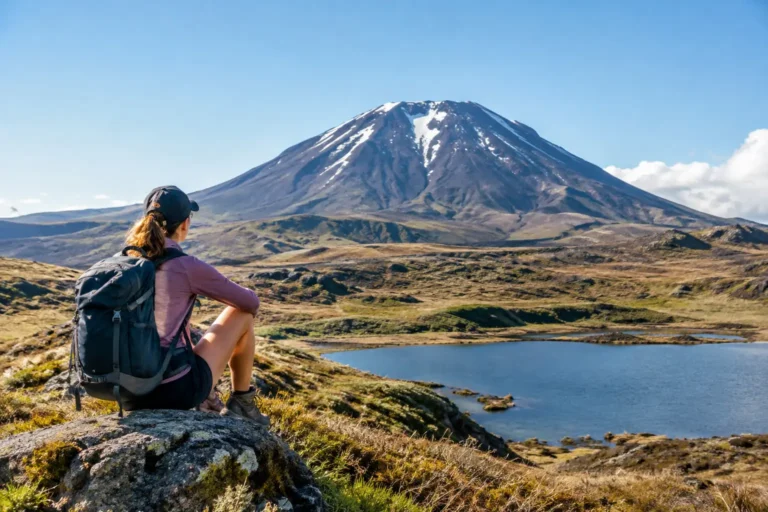
Tongariro weather can make an ordinary ride feel alpine, even when the route stays at lower elevation. Clear mornings can begin cool, the wind can build during the day, and conditions may vary noticeably between open country and sheltered forest.
Wear light layers that you can add or remove easily. A breathable base layer, warm mid-layer and windproof outer layer cover most situations better than one bulky garment. Padded bike shorts are optional, but comfortable shorts or leggings make a noticeable difference on longer rides. Closed footwear with a firm sole is a practical choice for pedalling and for short walks at viewpoints.
Pack water, food, sunscreen and sunglasses, even on a day that begins overcast. A small backpack is useful for spare layers and snacks, while a waterproof outer layer is sensible whenever the forecast is changeable. Gloves can also be welcome on cool mornings and long descents.
Helmet use is essential, and a hire provider should make sure it fits correctly. If you have not used an e-bike before, ask for a quick explanation of the display, gears, brakes and assistance settings. The controls are straightforward, but a clear introduction means you can focus on the scenery once you are on the trail.
E-bikes are excellent for mixed-ability groups because riders can choose different assistance levels while travelling together. The strongest rider does not need to race ahead, and less experienced riders do not need to worry about holding everyone back. That said, keep the group pace comfortable for the least confident rider, particularly on gravel, narrow sections and descents.
Build stops into the plan. The best photo opportunities, historic features and short side explorations are part of the experience, not delays. A realistic schedule also gives you time to pause for lunch and return equipment without rushing.
For a full-day ride, an early start is usually worthwhile. Trails are quieter, wind may be lighter and there is more flexibility if the group rides more slowly than expected. If your trip includes transport at either end, arrive early enough to load bikes, check fitting and understand the day’s timing.
Many of the area’s cycle routes are shared with walkers, runners and other riders. Keep left where appropriate, ride at a speed that allows you to stop comfortably, and slow right down when passing people or approaching blind corners. A friendly call or bell well before you pass is helpful, but give others time to respond.
Loose gravel, wet leaves, boardwalk approaches and changing surfaces all reward smooth riding. Brake before corners rather than through them, look where you want the bike to go, and leave extra room when descending. On steeper sections, lowering the assistance can sometimes make the bike feel more controlled than riding in its most powerful mode.
Look after the trail as well as your own group. Stay on the formed route, take all rubbish with you and respect closures or detours. These small habits help keep the tracks enjoyable for the next people through.
A little preparation at the beginning makes the day feel properly relaxed. Book the appropriate e-bike size in advance during busy periods, especially if you need several bikes or transport. Be clear about your intended route, experience level and the time you have available, as these details help local staff recommend a sensible option.
At The Alpine Centre, local advice can help connect bike hire, fitting and transport planning from one convenient National Park Village base. Ask questions before leaving: where the route starts, what the finish looks like, whether mobile coverage is likely to be limited, and when you need to return or meet a shuttle.
An e-bike day trip should leave you with energy for the rest of your holiday, not just a number of kilometres on a screen. Choose a route with room to stop, ride within the conditions, and let the central plateau landscape set the pace.